

Method: 100 project management software queries, split 30 category, 30 comparison, 20 alternative, 20 recommendation. Each was run once through ChatGPT with web search on, logged-out, United States, English, via DataForSEO’s scraper on September 8, 2026. Google’s top ten organic results were pulled for the same queries in the same window as a control, via the DataForSEO SERP API at depth 20 and truncated to the first ten organic results, so ads, videos and People Also Ask boxes do not eat the count. Every brand named, its position, whether it was recommended or merely listed, and every cited domain was coded against a rulebook written before collection. One run per query, so this is a teardown, not the benchmark. Frequencies describe this window only. Absence means not observed in this sample, never zero visibility. The query list, the rulebook and the coded data are available on request.
Everyone wants to know “are we visible in ChatGPT”. We picked one crowded category and asked the model a hundred times to find out what visible even means.
Being in the answer is not being the answer
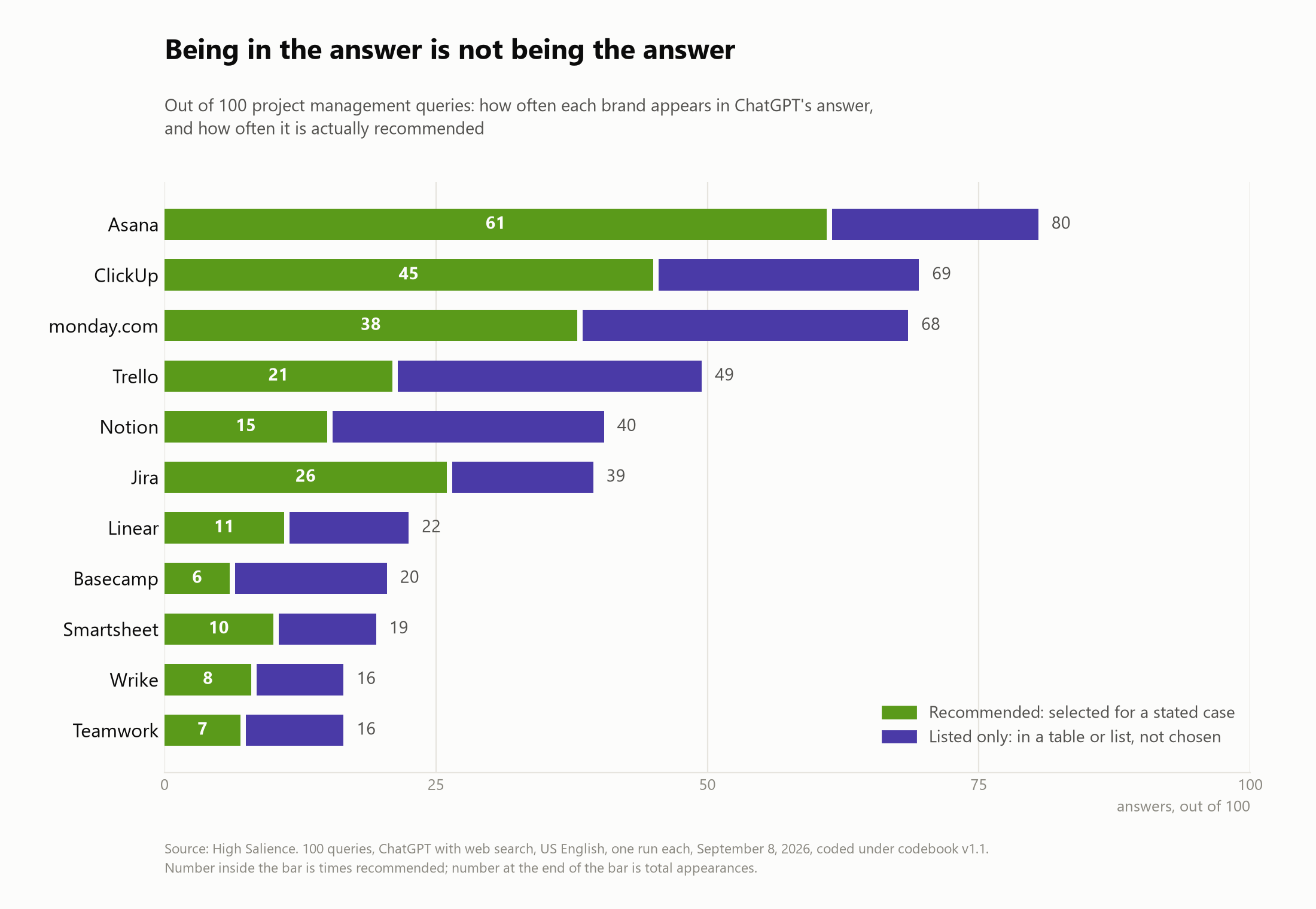
Out of 100 answers. “Recommended” means the answer selected the brand for a stated case: best overall, best for X, I’d start with. “Appears” adds brands that were listed in a table or bullet list without being chosen.
Notion is in 40 answers and chosen in 15. Basecamp is in 20 and chosen in 6. Trello is in half the answers and chosen in a fifth. Any tool that reports “mentions” would show these three as doing fine. They are furniture. The model puts them in the comparison table to look thorough and then tells the buyer to use Asana or ClickUp.
If your AI visibility report counts appearances, it is counting furniture.
A “vs” query is a fork, not a fight
We ran 30 head-to-head queries. Asana vs monday.com, Jira vs ClickUp, Notion vs Asana and so on.
In 28 of the 30, ChatGPT recommended every brand named in the query. The reply has one shape: pick A if you need this, pick B if you need that. One query produced a single winner, Smartsheet over Microsoft Project. One produced no pick at all.
So the model is not choosing between you and your competitor on a comparison query. It is choosing the conditions under which each of you wins, and then handing the buyer the conditions. Whoever wrote the clearest version of “use us when” owns their side of the fork. That’s an addressable content problem, and almost nobody addresses it.
When the buyer says “recommend”, the model commits
The 20 recommendation-intent queries are where the money is. “Which should I use for a five person team.” “What do you recommend for a marketing agency.”
Eighteen of twenty produced a clear recommendation among the general-market brands we coded. Asana was chosen in 11 of the 20, ClickUp in 8, monday.com in 4, Jira in 4, Trello in 3, Teamwork in 3. The other two abandoned that competitive set entirely, and we come back to them below.
Teamwork is the one to notice. It’s recommended in 7 answers overall, but 3 of those are recommendation-intent queries about agencies and client work. A brand with a narrow, specific frame can win the queries that match its frame while being invisible everywhere else. That’s a strategy, and it’s measurable.
The two queries that left the general field are the other lesson. Ask about a construction company and the model recommends Procore, Buildertrend and Fieldwire. Ask about a law firm and it recommends Clio. None of the eleven brands in the chart above appear. One word in the prompt swapped the entire competitive set.
Ranking in Google is a different game
For every query we also pulled Google’s top ten.
Of the 266 recommended brand mentions, 208 were for brands whose own website does not rank in Google’s top ten organic results for that query. That’s 78 percent.
This isn’t because those brands are weak in search. It’s because Google’s top ten for these queries is 75 percent listicles, review sites and comparison pages, not vendors. Only 254 of the 1,000 organic results we pulled were brand sites at all.
So the brand that ranks number one for “best project management software” is usually Forbes or Zapier, and the brand ChatGPT recommends is Asana. Rank tracking and recommendation tracking are watching two different games on two different fields.
The model cites the vendors, and mostly one vendor
Across 100 answers there were 362 citation events to 114 domains. Sixty percent of them went to vendors’ own sites. Half of all answers cited nothing but vendor pages.
The most-cited domain in the study is clickup.com, at 52 citations. Asana, the most-recommended brand, was cited 46 times. ClickUp earned its citations with its own comparison pages and “best tools” guides, which the model reads and quotes even when it then recommends someone else.
The most-cited third-party domain is G2 with 12. The Digital Project Manager has 8. Reddit and Wikipedia have zero in this sample, which matters because a broader corpus sample we pulled the same day, and will publish separately, shows Reddit in the top ten cited sources for this category. Same category, different sampling method, different answer. That is exactly why a single dashboard number cannot be trusted without its method attached.
Of the 362 citation events, counted as one per cited domain per answer, only 83 involved a domain that also sat in Google’s top ten organic results for that query. Twenty-three percent. The other seventy-seven percent of the evidence behind the recommendation lives outside the results a rank tracker shows you.
Two vendor tools, same day, as a check
We read Ahrefs Brand Radar and Semrush AI Visibility for the same brands on the same day. Their numbers are their own, built from their own prompt corpora, and are not comparable to ours. Direction is comparable.
Ahrefs’ topic table for project management software puts Asana first at 913 responses out of 1,062, then Trello at 868, ClickUp at 813, Jira at 742, monday.com at 600. Semrush’s domain view, which counts every prompt naming the brand, has Trello at 75.4K mentions to Asana’s 70.6K, but Trello at 5.3K citations to Asana’s 90.3K.
Three things line up. Asana is first everywhere. Trello is mentioned constantly and chosen rarely: second on Ahrefs mentions, first among pure-play tools on Semrush mentions, fifth on recommendations in our sample, and barely cited at all. ClickUp’s pages get cited well beyond how often the brand gets picked, on Semrush as in our data.
And one thing does not line up. Reddit is a top cited source in both vendor corpora and appears zero times in our live run. That is the sampling gap from the previous section, confirmed from two more directions.
What this changes
Four things.
Count recommendations, not mentions. Mentions are furniture.
On comparison queries, write the fork. State plainly when you are the right choice and when you are not. The model is going to say it anyway. Better it says it in your words.
Find the vertical prompts that swap the field, and decide whether you want to be in those fields.
Stop using Google rankings as a proxy for AI recommendation. In this sample the overlap was weak enough that the two need to be measured separately.
This teardown took one afternoon and a few dollars in API calls. It’s the same thing we do inside a Category Salience Brief, on your category, against your competitors, with the query set you approve first.
The full write-up, the chart and the downloadable dataset live on our own site: highsalience.com/research/project-management-teardown
Limitations: one run per query means answer variance is unmeasured; the benchmark that follows runs each query three times. The brand dictionary was built for the general project management market and deliberately does not score vertical tools. Sentiment coding was rule-based and is not reported here because the rules were too generous to trust. The ChatGPT scraper dropped six queries on first pass and all six were recovered on retry within the same window.